A message to new podcasters about titles and ID3 tags.

I just posted this to a forum, but thought I’d post it here too, so I can link to it easily when asked for podcasting advice.

Sort out your titles and ID3 tags right now!

Not every single person downloads podcasts via iTunes, which re-titles and stores the audio files using the information in the RSS feed. Many, many, many people, even regular listeners, download each episode with their browser, then transfer the file to a player.

So the following instructions goes for anyone starting a new podcast. You know the name of your podcast, right? Good. Now make sure you do the following from the very first episode:

– Begin the file name with the name of your podcast. If the name is really long, go for an acronym.
– The next part of your file name should be the episode number. This should be at least three digits long. Start with 001.
– The last part of your file name should be the topic or title of the episode.

If you do the above, the collected files from your podcast line up perfectly in any list of files and on immediate import into any software. If you start at “1” and go on to “2”, when you get to “11” it’ll be listed before “2” in many situations.

And so, even without ID3 tag information, your listeners will be able to quickly see what is what.

On to ID3 tags:

– Make sure the “genre” is set to “Podcast”! Many podcasts are categorized as a blues track! WTF?
– Make sure the track number matches the episode number.
– List the hosts and the guests in Artist category.
– Make sure the album info is the same in EVERY podcast from the first episode on.
– Set the year to the year you published the podcast.
– Adding artwork is good, but not crucial. iTunes and iPods like it though, as they display really nicely.

By the way, all of this takes seconds in iTunes. The only problem is that it can change the name of the file (not a bad thing) to include the track number at the start (the bad thing). In this case, just copy the file to a different location and change the name before you upload it.

Posted in Meta, Podcasts, SFBRP | Leave a comment

Where I write.

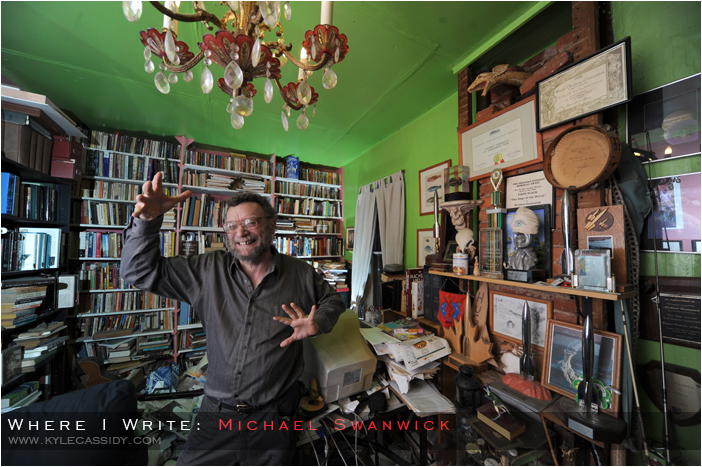
I’ve seen links all over to the website called Where I Write, which features photos of science fiction and fantasy authors in the places where they write. For example:

So, after seeing yet another link to the same website, I thought I’d share a photo of the place I write. I’ve got time to spare at the moment*, so got out the tripod:

Where I write.

Of course, I travel a lot, and much of my writing (and even more of my re-writing and editing) is accomplished while sitting in the same position but in hotel rooms and cruise ship staterooms around the world. But at home, when I write, I do it lounging in the living room.

Things in this photo:
– Me
– My laptop. It’s a MacBook, so often gets quite hot, which is why it isn’t on my lap.
– A very large couch. I can sit on this in many positions and orientations.
– A lamp. Reflected light off the wall is plenty to light my keyboard.
– A big piece of art. Made by Pola.
– A mobile. Made from twigs.
– A globe. It is very old and dated, but globes are the only way to really get a sense of the shape and size of different places in the world.
– A ladder. This leads to the bedroom/office.
– A window. This leads to the kitchen, important for the provision of drinks.
– A chandelier. Only turned on during large dinner parties.
– A blanket. Nice for if I get chilly.
– Three white boxes, stacked. These hold magazines, photo albums and many an atlas.
– A large fuzzy mat. This is to make the expanse of wooden floor more friendly.

Compared to the authors on the Where I Write website, my place is either more comfortable or more tidy than them all. John O’Niell looks comfy, but is surrounded by clutter. Nowhere near as much clutter as Samuel R. Delany, but it’s still there. John Harrison is tidy, but the room doesn’t look that inviting.

Why no mess for me? And why not sit at a desk?

First, all my notes are on my laptop, and my laptop is backed up every day. If I need to do research, I usually do it via electronic sources, online or via ebooks.

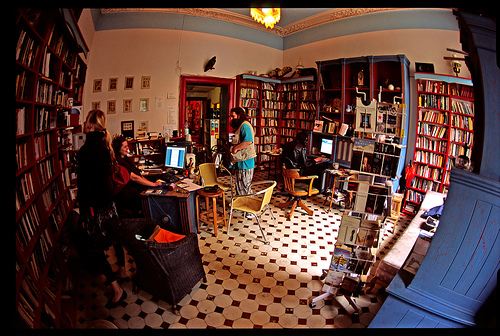
Second, I outsource my library/bookshelf functions to the Another Country bookshop, which is only a few hundred meters away, and has about 25,000 books. Any book I want I either borrow from there or buy it new from another shop, and then, to avoid clutter at home, donate the new books so borrowing books is free.

Berlin's Another Country bookshop.

Third, and this relates to no clutter as well as my comfort, I’m not a professional writer! Why the hell should I sit at a desk as though I’m working? I get paid for my writing, but not for my fiction. Like Ted Chiang, I write fiction because I enjoy it, and have a real job to support my hobby. That is, if being a professional juggler can count as a real job.

Catch you later…

* Due to recently becoming single for the first time in 4.5 years I’m not really into writing at the moment, nor much of anything. Regular posts will resume shorty.

Posted in Life, Meta, Photography, Writing | 1 Comment

Filter vs Datedness in old science fiction.

I got an interesting listener email about old science fiction. Here’s an excerpt:

Listening to your previous review of Jules Verne’s novel I remembered that as a kid I used to get his books from the library all the time, multiple times. Today however, I hesitate to read anything this old – for the only reason that it is old. Just as I wouldn’t want to buy, say, an old computer, I don’t want to read an old book. It’s quite curious, and a bit stupid really, because the old books tend to be the good stuff, with the junk weeded out over the years. You have probably read more old SF than I have, so do you think there is this “filter effect”? Or is it cancelled out by “disgraceful ageing” of the classics, SF in particular?

I like this question! I think there is a balance struck with many old books. It comes down to some interesting factors. First, “Likelihood of reading” things:

– Initial reception within a few years of publication – some books are huge, and you’d imagine everyone will still know them in the future. Maybe not. But this factor means there will be loads of copies of the book available in future second hand book shops.

– Time since last publication – the more recent, the easier it is to find work.

– Time between first and last publication – this is an indicator of the market’s sign of the continued commercial success of a work.

– Ease of purchase/reading – tied in with “last printing”, but with reference to Project Gutenburg and other electronic reading options. This has less to do with the final perceived quality, but more to do with the “how likely am I to read this?” question.

Now, to the “quality of reading experience” section:

– Thematic Compatibility – how many concepts are still relevant today? Are the attitudes dated? The greater this factor, the greater chance the more chance the book will be a good read.

– Scientific Longevity – how dated is the science? Even with a low value in this category, the thematic longevity factor can make up for it.

– Writing Style Compatibility – sometimes dated language is fine, if people are used to it. Shakespeare and the King James Bible means that 16th century English is still quite accessible today, and even re-surfaces in Fantasy titles.

These factors will, of course, influence each other. Maybe someone could make a handy equation. But it comes down to this: likelihood you will read the book/quality of book now compared to how it was received at first publication. Here are some examples I’ve read in the past few years:

The Time Machine – writing style slightly dated, themes just as relevant as ever, science hits more than misses (the time machine is fanciful, but the evolution and dying earth ideas are well explored). Holds up well.

Slan – much more recent, but the science is just stupid when read today. The writing style goes all over the place, and the attitudes of the main character are sooooo dated it almost hurt. The reason it survives is because people who loved it when it first came out are still alive… a nostalgia effect.

From the Earth to the Moon – Writing style really good fun, science hits and misses, themes aren’t so much relevant as not completely irrelevant.

Last and First Men – writing style is excruciating, attitudes of the author are dated, the science is dated. God, this book was a struggle. I should just do a review and ditch it.

Anyway, overall I think the most popular old science fiction falls into the “filter effect” category, and the “disgraceful aging” books just become old books. That Last and First Men is in the Masterworks series is understandable, but I really think it should be in the “influential and groundbreaking at the time, but superseded by many others” series. I don’t think that series would sell very well though.

Posted in Podcasts, Random, SFBRP | 2 Comments

Photos from July 2009

I’ve uploaded loads of photos this evening, from Portugal, Spain, Andorra, France, Switzerland, Norway, Svalbard, Iceland and Lichtenstein.

The first album, mainly holiday photos of Pola and I, can be found here: http://www.sosauce.com/album/9204/spain-andorra-france-july-2009/

The second album is more travel and wildlife oriented, and can be found here: http://www.sosauce.com/album/9205/arctic-trip-july-2009/

No bears this time! The closest I came was the warning sign in Longyearbyen:

But I did go reindeer hunting:

Check the albums for more of similar and even some very different.

Posted in Life, Photography, Travel | Leave a comment

Musings on my next novel project.

Earlier I wrote and posted about my “a short novel every three months” plan which sort of hit a snag in May. Not to worry, I’ll just move on. It’s not like I write for a living (a point I’ll touch on in a future post).

So, here’s where I’m up to regarding my August novel attempt, learning from my experiences of the last 10 months:

It has a working title. This makes it easier to talk about. Until someone comes up with a better idea I’ll be calling it “Combat Story (working title)”. As it is set in the same world as “Minding Tomorrow”, and deals with vision rather than memory I thought giving it the working title of “Blinding Tomorrow” and the third novel in the sequence “Finding Tomorrow” or something. But I think that would be a bit confusing.

I’ve decided to write a story idea that I’ve had for a looooong time. It’s been in my head so long that:
– some of the main ideas in “Minding Tomorrow” were actually first meant for “Combat Story”, like the viewsers and some of the brain imaging technology. And more besides, but that would spoil both novels.
– it features two characters from my first ever novel, a non-SF murder mystery, though they are minor characters in this story.
– knowing that the events of “Combat Story” happen in the same universe as “Minding Tomorrow”, I made sure to write them into that story too.
– this means that “Minding Tomorrow” features characters from “Combat Story” and vica versa, though only in minor and mysterious roles.

In the spirit of the “write what you know” rule, I’ve decided that juggling is going to feature in this story.

This novel is not a sequel, it is more of a companion novel. A reader could read either “Minding Tomorrow” or “Combat Story” first, and it won’t spoil the other.

Also, it is going to be a different style… a more direct narrative, and a lot more action. It could even be classed as military SF, but I’m thinking more along the lines of “near future, hard science fiction, action heavy, techno-thriller” vibe.

To make sure I know exactly what is happening, I’ve made notes. A LOT of notes. About the plot, characters, ideas, everything. I’ve listed all the scenes, and what needs to happen in each. I mean, I’m up to about 6,000 words of notes, and I still have a few thousand more to go before I’m set. When I start writing in a few days time I’ll be able to hit the ground running.

Unlike “Monster Story (working title)”, where I didn’t name any characters (I don’t like naming things), and instead used place holders like AAAA, BBBB, etc, this time I’ve given all the characters names from the start. The names may change, but I hope they’ll lead to some interesting character moments

I plan for “Combat Story” to be longer than my other two completed novels. I’m not sure of the exact length, but it might clock in at 70,000 words.

Instead of focusing on word count, I’m going to focus on scenes/chapters. Each day I’ll write a scene. Or two. I actually have between forty and fifty scenes, but I know some of those aren’t needed, and I know new scenes will present themselves as I progress. Like in “Monster Story”, a line in my notes like “Two characters do X” would take four chapters, and a huge stretch of notes about what information needed to be shared with the reader would be CONDENSED by the time it got into the story. I’ll just have to busk this as I go along.

To keep myself honest, I’ll still be keeping track of my word count, and aim for about 1,500 per day. I might even post word count updates on twitter, so my followers can bug me if I skip a day. Unless it pisses them off.

Anyway, I’m really looking forward to the new adventure. I know by putting the work in up-front, it will take a lot less editing afterward. Judging by initial feedback for “Monster Story” I think I’m getting to the point where my stories are more suitable for release a lot quicker than before. Maybe, if I’m happy with it, I could get it out before the end of the year.

And who knows, if I do a NaNoWriMo novel in November, and release that story quickly too (another story I’ve had in my mind for years), I might release four novels within a year. This time last year I’d never believe that to be possible for a non-full-time writer, but here I am giving it a good shot.

Posted in Juggling, Life, Meta, Writing | 1 Comment